Aston Martin Design Director Marek Reichman
Aston Martin aims for the new Lagonda to
prosper in the Middle East , from where, Reichman
indicated that there has been “specific market
demand” for this type of car. Estimations show that
60-70 per cent of the surviving Lagonda models of
the last production can now be found in the Middle
East.
“Lagonda has an impeccable heritage. It was a
Le Mans winner in the pre-war era and was part
of the avant-garde; it was always offering something
different. David Brown bought the Lagonda brand
[in 1947] and commissioned William Towns to stick
with that. It [the 1976 Lagonda] was an attractive
aesthetic; it was the lowest four-door car with a
remarkably low roofline. It had daring interior
technology and was a very brave car.”
The Lagonda project was executed swiftly, with
just eightmonths between the initial studio sketches
and the final full-size model. This was a remarkable
effort when compared to the production of the
Aston Martin One-77, which took two years from
first studio sketches to final production. In the
words of Marek Reichman “From the first scale
models, we just knew it would be right…When the
first model was revealed, the reaction was, ‘Wow’”.
“This car is not retrospective. There’s a feeling of
drama with the low nose, the continuous flat face
and the speed of the A-pillars. The rear of the roofline
pulls up over the rear edge of the roof, emphasising
the importance of the rear passengers.”
“We call this car a ‘super-sport sedan’,”
-Reichman
continues.. “It’s very powerful at the rear, and very
wide at the rear. The rear track is the widest we
have ever done.” Reichman also states one of its
most praised reference as its close resemblance to
the classic Riva powerboat - pointing out the flat
shoulder that runs down the side of the car and
into the rear deck.
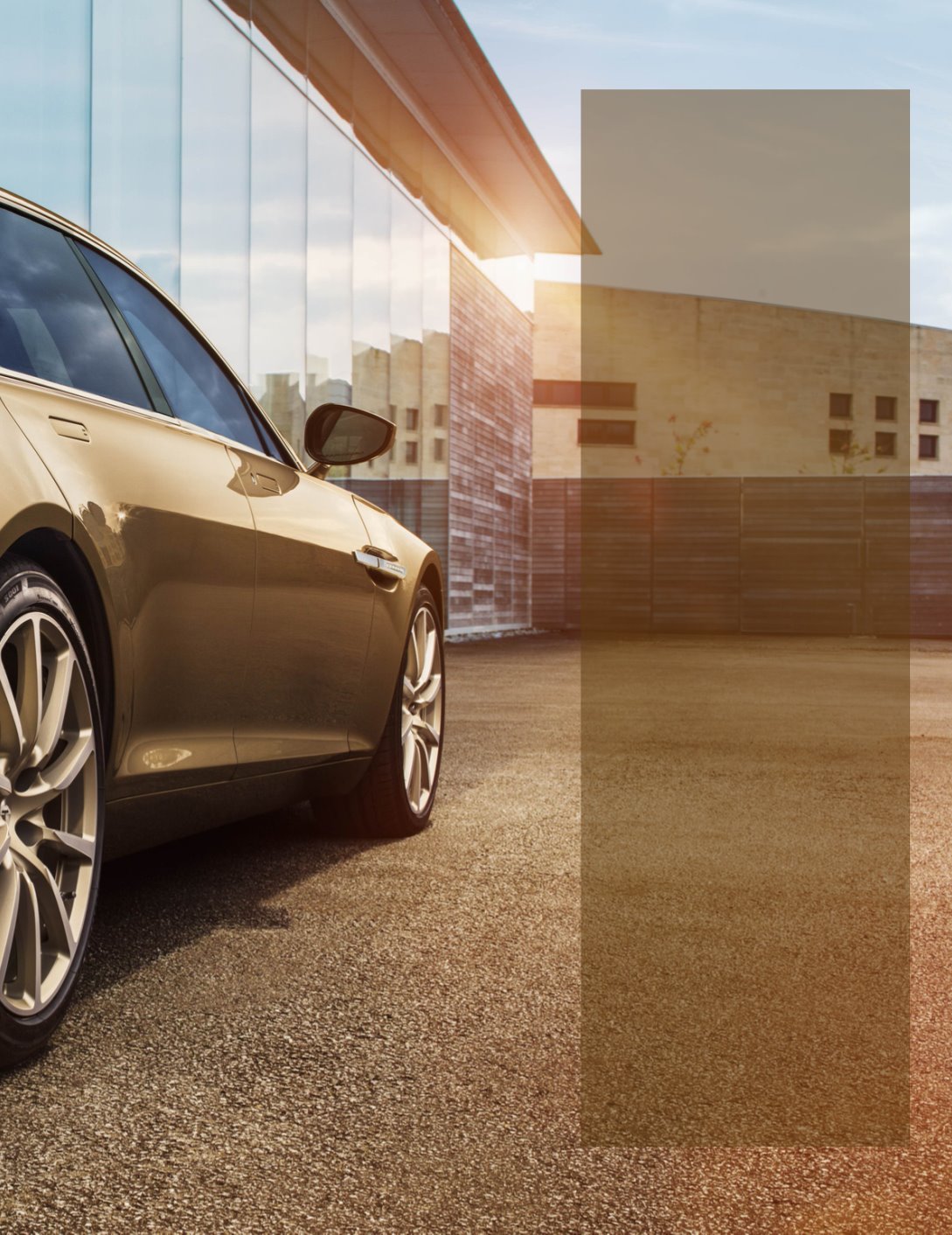
On the body works the new Lagonda is a
muscular machine, which, despite some significant
juxtapositions of design, comes together in unseen
manner. The new Lagonda Taraf mixes the its
voluptuous surfaces with a sense of edginess giving
the car an all round sleek feel. This effect can be
seen in the rear door skin and rear wing which is a
new enhancement from Town’s 1976 model.
The Lagonda is constructed frompanels moulded
from carbon fibre-reinforced plastic (CFRP),
which are, in turn, partly bonded directly to the
aluminium surfaces of Aston’s VH platform. One
of the most impressive things about the Lagonda
is its liquid-like surfaces ,which has a precision
pressed steel look. Reichman’s design team has
achieved something quite impressive with this
moulded material. “Endless work was done on
the surface quality and surface finish,” explains
Reichman. This highly polished, almost flawless
surface language may just be one of the many
defining achievements of the nine years Marek
Reichman has spent at Aston Martin.
252
Legatto Lifestyle
Cars: Editor’s Pick


